Goodbye, Keyword Data: Google Moves Entirely to Secure Search - The day many SEO professionals hoped would never come, but feared
eventually would, apparently has arrived today. It appears that Google
has cut off keyword data altogether.
Nearly two years after making one of the biggest changes to secure search
that resulted in a steady rise in "(not provided)" data, Google has
switched all searches over to encrypted searches using HTTPS. This means
no more keyword data will be passed to site owners.
Encrypted Google searches don't pass the keyword data through to
websites, thereby eliminating the ability to track users by their
keyword searches. The biggest impact for many site owners has been not
being able to segment users by keywords within their web analytics
software.
To publish any intention of Google's motives for this move would be
pure speculation. Not wanting to feed the rumor mill or feed any false
speculation, Search Engine Watch has reached out to Google for a
comment.
"We added SSL encryption for our signed-in search users in 2011, as
well as searches from the Chrome omnibox earlier this year," a Google
spokesperson told Search Engine Watch. "We’re now working to bring this
extra protection to more users who are not signed in."
When encrypted search initially launched in May 2010, Google initially had encrypted search on a separate URL. A year later, in late 2011, Google started redirecting all U.S. users who were signed into their Google Accounts
to the encrypted version at https://google.com. This led to the
now-infamous "(not provided)" row in keywords data in Google Analytics
and other web traffic software packages.
When questioned, Cutts was quick to respond that it was estimated
that the amount of "(not provided)" visits "even at full roll-out ...
would still be in the single-digit percentages of all Google searchers
on Google.com."
As time rolled on, the conversion to encrypted search expanded globally to all signed-in users then even further to include default searching in Firefox
Just last month, BrightEdge released a study fining the percentage of "(not provided)" data was over 50 percent for some industries.
There are methods around determining "(not provided)" data via Webmaster Tools. While the method isn't fullproof, it can be useful to determine trends.
At this point, it seems even when you aren't logged in, using private
browsing (or incognito mode) and forcibly type HTTP://www.google.com,
you are being redirected to the HTTPS version, thereby encrypting your
search and no doubt leading to a total removal of keyword data – at
least from Google search visitors. Remember, keyword data from other
search engines – like Bing, for example – still send keyword data
through.
If you're a practitioner, how will you be adjusting your strategies
and practices? How will you begin the conversation with your clients?
Sound off in the comments. We'll have reactions and more coverage as
this story develops.
source:http://searchenginewatch.com
Showing posts with label Blogging. Show all posts
Wednesday, September 25, 2013
Sunday, December 23, 2012
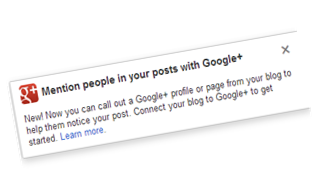
Now You can Mention People inside Blog Posts with Google Plus!
Believing in the importance of smooth conversations in between the publishers and the readers, Google has now introduced a new way to link your devoted readers in your blogger post editor.
How to Link People?
Everybody loves to have an attention, its human nature. When it comes to
your devoted readers, who contribute on your posts, sharing the best of
their ideas, adding useful stuff on your blog, you really need to take
them in consideration. With this new option, been introduced by Blogger,
you can now add links of Google+ profile your readers, if needed. You
can even link Google+ pages when you have to mention a person or a page in your blog
Here it is that how can you value your readers or people who somehow relates to your post.
1) Type “+” in your Blogger post Editor, followed by the name of the person who you want to add in your post.
2) The link would then be shown in your post
3) After sharing your post from Blogger to Google+, the linked person would be notified in the sharebox.
4) Clicking on the link would redirect the readers to the person’s Google+ account.
Therefore, If you have some dedicated readers or hard-working co-authors
like us, then you can now credit them by adding their Google+ links in
your post.
Hoping to get some good notifications in my sharebox by Mohammad and
other readers, (:D) from now onwards, leaving you on a note that value
people who can contribute in your success!
Best Wishes,
Friday, May 11, 2012
How to get traffic for your blog
1. Use lists.
2. Be topical... write posts that need to be read right now.
3. Learn enough to become the expert in your field.
4. Break news.
5. Be timeless... write posts that will be readable in a year.
6. Be among the first with a great blog on your topic, then encourage others to blog on the same topic.
7. Share your expertise generously so people recognize it and depend on you.
8. Announce news.
9. Write short, pithy posts.
10. Encourage your readers to help you manipulate the technorati top blog list.
11. Don't write about your cat, your boyfriend or your kids.
12. Write long, definitive posts.
13. Write about your kids.
14. Be snarky. Write nearly libelous things about fellow bloggers, daring them to respond (with links back to you) on their blog.
15. Be sycophantic. Share linklove and expect some back.
16. Include polls, meters and other eye candy.
17. Tag your posts. Use del.ico.us.
18. Coin a term or two.
19. Do email interviews with the well-known.
20. Answer your email.
21. Use photos. Salacious ones are best.
22. Be anonymous.
23. Encourage your readers to digg your posts. (and to use furl and reddit). Do it with every post.
24. Post your photos on flickr.
25. Encourage your readers to subscribe by RSS.
26. Start at the beginning and take your readers through a months-long education.
27. Include comments so your blog becomes a virtual water cooler that feeds itself.
28. Assume that every day is the beginning, because you always have new readers.
29. Highlight your best posts on your Squidoo lens.
30. Point to useful but little-known resources.
31. Write about stuff that appeals to the majority of current blog readers--like gadgets and web 2.0.
32. Write about Google.
33. Have relevant ads that are even better than your content.
34. Don't include comments, people will cross post their responses.
35. Write posts that each include dozens of trackbacks to dozens of blog posts so that people will notice you.
36. Run no ads.
37. Keep tweaking your template to make it include every conceivable bell or whistle.
38. Write about blogging.
39. Digest the good ideas of other people, all day, every day.
40. Invent a whole new kind of art or interaction.
41. Post on weekdays, because there are more readers.
42. Write about a never-ending parade of different topics so you don't bore your readers.
43. Post on weekends, because there are fewer new posts.
44. Don't interrupt your writing with a lot of links.
45. Dress your blog (fonts and design) as well as you would dress yourself for a meeting with a stranger.
46. Edit yourself. Ruthlessly.
47. Don't promote yourself and your business or your books or your projects at the expense of the reader's attention.
48. Be patient.
49. Give credit to those that inspired, it makes your writing more useful.
50. Ping technorati. Or have someone smarter than me tell you how to do it automatically.
51. Write about only one thing, in ever-deepening detail, so you become definitive.
52. Write in English.
53. Better, write in Chinese.
54. Write about obscure stuff that appeals to an obsessed minority.
55. Don't be boring.
56. Write stuff that people want to read and share.
(Based on seth's Blog)
The Future Value of Your Blog
All the hype about the sale of Weblogs Inc. to America Online (AOL) has given rise to the now famous question – How much is your blog worth? In acquiring Weblogs Inc., AOL has provided some concrete metrics to future valuation of blogs. How much will traditional media be willing to pay for a blog? Conversely, how much would you sell your blog for?
AOL-Weblogs Inc. Deal – Benchmark for Future Blog Valuation
Weblogs Inc was established by Jason Calacanis and Brian Alvey in 2003. It is a network of blogs which includes under its wings successful blogs such as Engadget and Autoblog. Jason Calacanis pointed out that Weblogs Inc. earns in excess of $1 million yearly in Google Adsense revenues alone.
AOL purchased Weblogs Inc. for a confidential sum assessed at somewhere between $25 - $40 million. After said purchase, Tristan Louis came up with a blog valuation scheme based on the deal. He created a chart of blog value using the value of each inbound link to Weblogs Inc. as the basis. It is common knowledge that blog readers follow links. Search engines also act as users and primarily determine blog quality rankings based on linkage data thus direct and indirect value links are a great proxy for value measurement. In the blogosphere, conversations that nurture connectivity represented by links and indexes like Technorati give a vantage view of the value of a blog.
Tristan Louis itemized the publicly available data (list of blogs indexed) at Weblogs Inc. network including the number of inbound links (Technorati blog numbers) per blog divided by the purchase price to determine the value of an inbound link to a blog. At the rumored price of $25 million, the estimated value is $ 564 per link. At $30 million, it is $677.57 per link and $903.42 at an acquisition price of $40 million. Interestingly, the consumer segment chalks up the biggest percentage of linkage. Engadget represents over a third of the overall network traffic.
Applying Tristan Louis’s Weblogs Inc, sale, Dave Winer has also sold http://Weblogs.com to Verisign for a rumored price of around $2 million. Blog entrepreneur Nick Denton, founder of Gawker Media has signed a deal with VNU Media to publish Gizmodo (gadget blog) across Europe in six languages. VNU Media is a leading worldwide information and media company which owns ACNielsen, Billboard, The Hollywood Reporter, among others. With this deal, blog publishing has hit big time.
However, the value of a blog is not calculated based solely on links using AOL’s purchase of Weblogs Inc. Jason Calacanis, the man behind Weblogs Inc., disputed using links alone as proxy for the value of the blog network. He reiterated that the acquisition price was based also on the ever reliable revenue, earnings, management and other metrics.
Tristan Louis based his valuation scheme on links to a blog but he also acknowledged the significance of technology, talented management team, financial performance and growth. There is direct correlation between links, traffic, revenue and earnings capacity of a blog or blog network but it takes sound management to maximize all these potentials.
Value of a Blog – Some Metrics to Consider
How much is your blog worth? There is no one standard gauge yet. But one way to measure the value is to look at certain factors to gain a better perspective on how to measure the future value of a blog.
Aside from number of links as mentioned earlier, traffic level is a key factor in determining blog value. Highly trafficked blogs definitely have a bigger potential for earning compared with those blogs with few readership. A blog’s success is highly dependent on visitors/readers. However, ascertaining the value of traffic is a thorny issue. Some bloggers value traffic anywhere from $3 to $10 per hit a day. From this data, a blog with 2000 unique visitors (page views) would be worth between $6000 to $20,000. The downside to this valuation approach is that some traffic is more valuable than others. A personal blog might have 1000 unique visitors but more difficult to convert to revenue than a blog with 1000 readers that blogs on the topic of digital cameras.
Aside from diverse traffic streams that come from bookmarks, direct links or RSS subscribers will make risk of losing traffic low. Social bookmarking sites are inching their way to becoming prime sources of traffic, with peer referral at times carrying more weight than search results. There are a number of well known bookmarking sites you should link to. Top bookmarking sites include Furl, http://del.icio.us, Diggs, to name a few. By leaving an RSS (Really Simple Syndication) feed, you can feed you readers’ desire for information. Visitors can get automatic updates whenever you provide new content. Having a fairly good base of bookmarkers and subscribers ensure a steady flow of fans and repeat readers – the all-important traffic.
In the blogosphere as in any other field, revenue or earnings is a major focus. a logical approach to blog valuation would be to base its worth upon current and projected earnings, assuming that your blog is earning something to start with. Again, there are varying views on how to use current earnings to measure a blog’s value.
Some bloggers opine you should expect six to eight months earnings as your blog value. A blog with a daily income of $150 would be worth between $27,000 - $36,000. Still, others determine a blog’s value as being two years of current earnings. A blog earning $150 a day would be worth $108,000. Again, there is a huge disparity between these methods of assessing value. Having diverse streams in the form of multiple affiliate programs also increases blog revenue. An affiliate program is an advertising model in which a blog owner markets via his blog a given product, on behalf of another company. The blog owner is reimbursed a percentage of all sales sold thru his affiliate link. Reimbursement rates can vary from 1% and upwards. Google Adsense is a prime example.
Visitors access blogs throughout the Internet primarily through search engines. If your blog does not have a post appearing in the top ten search engine rankings, the chances of visitors reaching your blog is low. A blog’s presence on relevant search engines is a significant medium for maintaining a blog’s success. Search engine ranking and pages indexed in search engines is critical for generating traffic to a blog. Having your blog among the top results of a search or receiving a high Google PageRank (a system for ranking blog posts) would increase your blog’s overall value.
High quality content will always be a key factor for determining a blog’s value. As has been said time and time again – Content is King. Moreover, search engines can only “read” a blog. What attracts a search engine are the words, the content of a blog that explains, informs, shares and educates readers. Good content increases blog value.
All these aforementioned objective metrics can be considered in assessing the value of a blog. Added to all these, a talented management team behind a blog, its underlying tools and blog technology in use can further help to estimate the future value of a blog.
-----------------
Danny Wirken
Source: Free Article Directory
Search And Submit Articles
Tuesday, May 1, 2012
Blogging Can Be A Great SEO Tool
Great SEO Tools take advantage of your normal working methods to give you an added edge. They're non-intrusive but great in terms of improving your search engine rankings. One such tool is the blog.
You can look at a blog from several perspectives. For most people, it is just a simple self-expression method, others see it as a discussion forum. However, if you look at a blog not only as all of the above but also as a SEO tool, your handling of the blog will change. How you write your posts will change. How you think about your blog will change. You'll then be able to derive great business value from your blog.
The Many Methods of SEO
Search engine optimization, in a nutshell, involves anything that improves your ratings in the popular search engines, like Google, MSN & Yahoo. The higher your ranking, the greater the chance that a new customer will see your site in the first page of search engine outputs. While you can improve the structure and linking of your site by practicing techniques of on-line and off-line optimization, such as adding meta-tags and sitemaps, you need other methods to increase the popularity of your site.
Blogging is one such method. Blogs traditionally have a large number of posts on them that relate to a specific subject. Readers who are interested will come to the blog, read what is on offer, agree / disagree and leave feedback and comments. If you promote your blog actively, you will also visit the blogs of your readers, and leave comments on their sites along with a link back to your blog. Can you see how the blog is beginning to behave like a SEO tool?
Two things happen if you handle this well – your blog gets lots of keyword rich content and it gets a lot of links to itself from other sites. Either way, your business gains.
Search Engines Love Blogs
Search engines love keyword rich content and inbound links. While traditional SEO tools do this by making you manage links to other sites and increase or optimize keyword usage, your blog is doing this in the most natural way and gives you a great big, ready-made user base!
Of course, before your blog does become your SEO tool of choice, there is a lot of work to be done. You will not be able to build the niche you are looking for if you do not focus completely on the quality of your blog. This means that your content has to be great and the better than average informed reader still has to find something worth reading on your blog.
While keeping a blog can be a great satisfaction in itself, there are many business related benefits to keeping one. A good blog is a natural SEO tool that attracts traffic to your site in the most natural way.
-----------------
About the author
Deborah Carraro is a succcessful online entrepreneur who got her start in the Inner Circle with many top Online Entrepreneurs and is now sharing their business blueprints & online secrets with you. You can get a free subscription to her “Partner for Profits” ezine at http://www.myvirtualpartner.com Article Source: Free Article Directory - http://www.articleManiac.com Search And Submit Articles
3 Key Off-Page SOE Methods
On-page search engine optimization is definitely one of the key methods if a website owner would like to improve the results for his or her website's searchability. However, on-page SEO often entails technical skills. Why? Not a lot of people are HTML enthusiasts. This is often what needs to be tweaked to do an excellent job in optimizing web pages.
What if a geek friend already did the on-page optimization and now you want to know how you can contribute to the "search engine goodness" of your website? Off-page optimization is the next step. And the results you will have to pine for are one-way backlinks. Why? This is how many of the major search engines such Google, Yahoo! and MSN rank websites. The more backlinks from relevant sites with good page rank, the merrier.
So how exactly do you gather backlinks? It's not an easy task but it's definitely less nerve-wracking than HTML if you are not the techie type. Here are some off-page SEO tips:
1. Article Marketing
Quality content has been discovered to be real king. Everyone is hungry for fresh and quality info and providing it will make backlinks go pouring in. It helps a lot to be a keen writer to be successful on this endeavor. Also, practise the proper way of using a resource box. It should only include a website that contains information relevant to the article you submit to article directories.
2. Forum Participation
Look for forums that are relevant to your website's content and keep on sharing information that will be indispensable for the members of the forums. Your signature or that tag-along message at the last part of each of your posts is what will work for your off-page SEO campaign. Keep it simple and make sure that it conveys something about your website. Learn how to hyperlink to make it easy for the people who want to visit your site.
3. Blogging
Blogs or web logs are now the most popular weapons of SEO experts. Aside from being easy-to-update, they don't require a too formal tone, which is what many readers are into. Informal dialog which can be accomplished through readers leaving comments and the blog author replying to the comments is what also keeps blogs fresh and search engine friendly. Maintaining a blog that's again relevant to your website's content will keep the search engines in touch with your site. Don't forget to have a link on your main website from your blog.
The secret to be successful in carrying out these off-page SEO methods is to be consistent. Submitting quality articles to websites at least two to three times a week and regularly producing content for your personalized blog is a surefire way to make your website stand out. Forum participation should also be something done more frequently since it will not only help you up your website's popularity with the search engines but also make you learn new stuff from other forum members' participation. Also, if you discover that you don't enjoy these stuff, there's always a plan B - hire someone to do them for you!
Note: This article may be freely reproduced as long as the AUTHOR'S resource box at the bottom of this article is included and all links must be Active/Linkable with no syntax changes.
http://adsense-journal.blogspot.com/2009/01/3-key-off-page-soe-methods.html
5 Build Your Online Info-Business Common Problem Solved
5 Problems with "Common Build Your Online Info-Business" Sites
1. Assumptions
Many sites and courses take certain things for granted…like your ability to create a web page, or generate traffic. You need to have some technical savvy in order to follow the "steps". If you've never built a web site before, or have very limited experience, this can be one of the most daunting parts of starting a blog.
2. Overviews
While a how-to may take you step by general step through the basics of setting up a blog or online product page…the steps are usually very broad. You may be told to "design a front page", or "set up a vendor for processing payments". You may not, however, be told how to do each of these things.
3. DIY (Do-It-Yourself)
You're on your own with the information. If you don't understand a part of it, you can usually submit questions, but there's not a "go to" resource for figuring out part of the process. Many e-course designers or marketers are more than happy to help…to a degree…but don't have mechanisms built in for very involved technical help. At times, you may even be referred to alternative courses designed to help you complete these steps. Who wants to spend even more money when the course was supposed to be step by step?
4. Task Volume
There's just A LOT to do when starting an e-business from scratch. How do you prioritize?
5. Ambiguous Expectations
There are so many variables involved…it's hard to know how or when to expect any income. Let’s face it…we're not doing this for our health. When will you get paid? How do you plan for income from something so new to you?
The "Income Blogging Guide" is the Solution!
We've created this guide as a solution to the problems most people have when starting an online info business from scratch. Step by step by step.
Okay, but why the 3rd "by step"? Good question.
You see, in each of the problems above, the problem lies in incomplete information. A step by step approach is great, if you know how to perform each of the steps. What happens when you don't? You need another "by step" for each of the steps you may struggle with.
How are you supposed to follow the gurus when one tells you "You need a niche" and the next one says, "Build a list"? Another says, "Create and sell your own products", and the next says "Sell other peoples' products".
"Learn SEO and PPC…"
"Give away something for free..."
"Build a relationship with your customers…"
"Optimize your blog…"
"Use plug-ins…"
"Content is king…write everyday…"
"Use the best keywords…"
Blah, blah, blah ...
There is a lot of confusing information out there. Chances are, you already know how to do some of these things, but need help on others.
Know how to find a great market niche and write a successful blog? Great, you don't need the steps within each of these components. Know how to design the web page and overcome technical difficulties? No? No problem, we have a deeper level of instruction for that!
Step by step by step!!
The Income Blogging Guide is here to show you how to make it work… Find out here!
http://adsense-journal.blogspot.com/2011/03/5-build-your-online-info-business.html
Sunday, April 29, 2012
Killer Income From Blogging. Awesome Free Guide!
Finally there is a step-by-step guide that shows you the exact steps you have to take to make your own blog and start making an income. Right from deciding upon a niche that sells, to choosing a domain name to making your blog quickly indexed and also very secure to making money.
And it's all clearly explained in a step-by-step approach with screen shots and videos. You simply cannot go wrong.
This is what others are saying about the free guide:
"I downloaded the free guide yesterday. Today, my blog is up and running. Excluding the wait for the hosting to be set up, it took me 38 minutes!"
"You guys are absolutely brill. I was just about to throw my computer out the window when I came across your free guide. I still have a long way to go but I now have my blog and I can now learn how to use it to my full advantage, cheers you're brill!!!"
"Thanks for that great guide and you didn't even charge a dime!"
"It was my first try and the blog was up and running in no time! Thank You SO MUCH!!"
"Love the new guide. You go into great detail on some of those tricky points, especially around downloading and installing WordPress, and with plugins. Thanks again for the fantastic advice."
"I've had my domain for a while, I hadn't managed to get my head around wordpress installation. Following your very clear instructions, I've installed the blog myself in about an hour. So, that's exciting, and impressive, I reckon."
If you want to discover:
- The 2-step process you need to choose a proven money-making niche...get it wrong and you'll never make any money
- The 3 golden rules of keyword analysis...get one rule wrong and ALL your future efforts are wasted.
- The exact step-by-step methods to find the best domain name for your blog ...99% of bloggers miss this crucial "Search Engine Optimization" step
- How to install WordPress in under 1 minute (as long as you choose the right hosting company)
- Step-by-step guides and images of each 'must-have' plugin you must install on your blog (plus all the tweaks necessary - it is not just a matter of installing)
- The 2 steps you need to take to get Google to index your blog...and don't believe all the hype...they take no more than 10 minutes to complete
- Don't be one of those blog owners whose blog is 'hacked...follow these 6 tasks that keep 99% of hackers at bay
- How to add pages, posts and images the right way, to pick up Google "link-juice" and without being penalised for duplicate content
- To launch your blog, what's the optimum number of blog posts you should have? The answer may surprise you.
- How to write blogs posts so that your visitors think "I like this person, they know what they are talking about. I wonder what else they have to say" ...and return time and time again
- How to write a good title for a blog post and why "Here are the top 20 tips for XXXX" is a no-no.
- The 5 quickest and easiest ways to start making a blog income...including the step-by-step approach
- How to split your working day into the 3 crucial elements of making money via blogging
- The 3 traits of a successful blogger...do you have them?
Then grab the free guide by clicking here and welcome to the successful Internet Business Club:
source:http://adsense-journal.blogspot.com/2011/02/killer-income-from-blogging-awesome.html
Subscribe to:
Posts (Atom)
